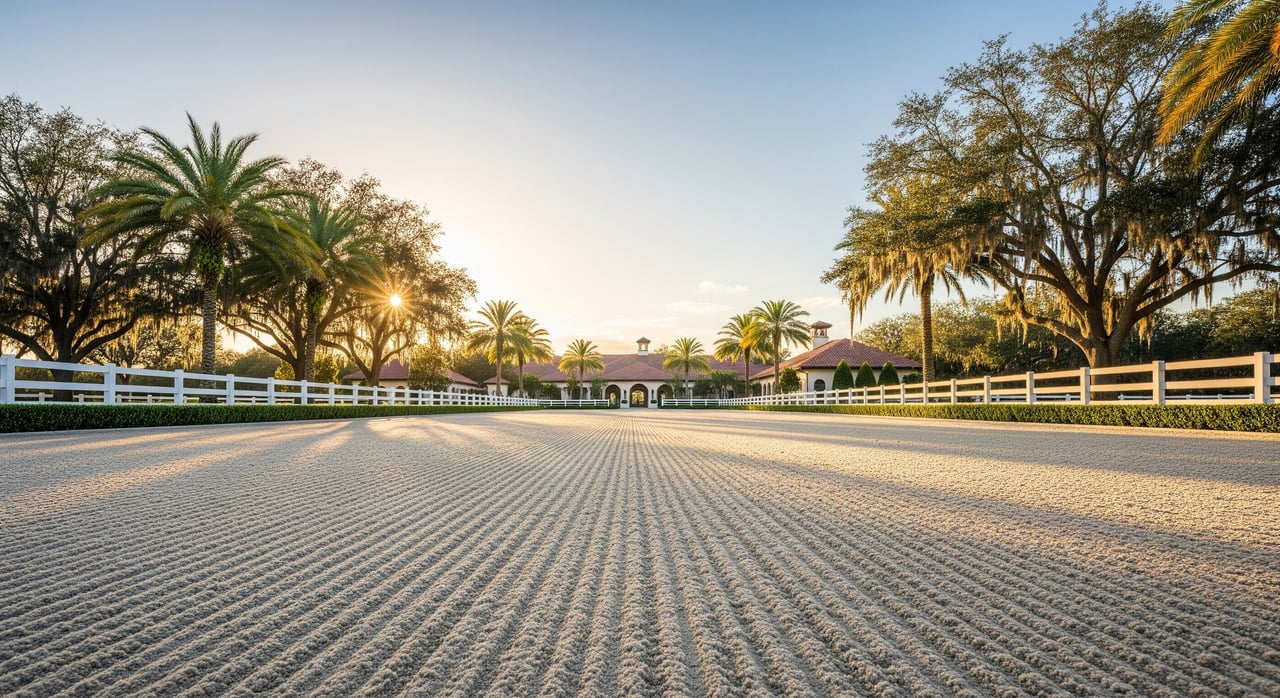
Your arena should ride the same on a breezy January morning as it does after an afternoon thunderstorm. In Wellington’s Equestrian Preserve, that is not luck. It is the result of smart footing selection, a robust base and drainage plan, and daily care that fits our wet-and-dry seasonal cycle. If you are designing, updating, or evaluating an arena, you want a surface that is safe, consistent, and efficient to maintain.
This guide breaks down what works in South Florida, how different footing types behave here, and the base, drainage, and maintenance steps that keep your arena competition ready year-round. Let’s dive in.
Wellington climate essentials
Wellington has a distinct wet season with intense summer rains and a dry season with low humidity and wind. You also face high heat, high humidity, and a generally high water table. These conditions shape every footing decision you make.
Your footing should deliver four things: consistent shock absorption, reliable traction in wet and dry conditions, low dust in the dry months, and fast, controlled drainage after storms. In high-use arenas, you also need durability under heavy traffic and frequent reconfigurations.
Sand-only arenas: when they work
Sand can be a solid, lower-cost option when it is engineered for arenas and paired with a strong base. Well-graded, angular sand drains predictably and offers decent traction. The key is choosing the right sand and staying on top of maintenance.
Fine sands, or sand with silt, clay, or shell content, tend to hold water and get muddy during heavy rain. Coastal carbonate or shell sands can break down faster, producing fines that clog drainage and increase dust later. Dust control is also a challenge in the dry season unless you irrigate or treat the surface.
Sand specs to request
- Ask for a sieve analysis and fines content report.
- Confirm low organic content and particle shape suited for traction.
- Choose engineered arena sand over native or on-site sand.
- Pair the sand with a well-draining base and regular grooming.
Fiber blends: stability and consistency
Sand mixed with short synthetic fibers improves surface cohesion and vertical support. In Wellington’s storms and heat, this helps the footing resist wash-out and stay even after rain. Fiber blends also tend to reduce dust because fibers help lock particles together.
You will pay more up front and need precise mixing and installation. Fiber type, length, and dose must match your sand gradation. In return, you get a more consistent ride across weather swings and heavy use. Choose UV-stable fibers designed for hot, humid climates.
Textile systems: cushion and moisture
Synthetic textile blends or geotextile layers add cushion and water-holding capacity. This can improve shock absorption and traction while supporting dust control in the dry season. Textile systems require careful base design and underdrain so water does not sit in the layer. Confirm that materials are UV and salt-air resistant and ask for field performance data from similar climates.
Coated sands and polymer additives
Polymer or wax-coated sands bind particles to reduce dust and migration while improving traction. These surfaces can offer excellent consistency year-round and better tolerance to water. They cost more and may need periodic topdressing or replenishment, so weigh initial cost against reduced dust and maintenance benefits.
Choose coatings rated for longevity in warm, humid conditions. Ask about expected lifespan and maintenance schedules for South Florida.
Materials to use sparingly
Organic additions like wood chips or peat can add cushion, but they break down quickly in heat and humidity. They tend to hold excess moisture and can lead to odor and higher maintenance. Rubber can add cushion, but it behaves differently in high heat and strong sun. Reserve it for selective use and test in small areas before committing.
Discipline-specific guidance
Different disciplines place different loads on your footing. Calibrate depth and material accordingly.
- Dressage: You want a smooth, even surface with moderate depth and consistent energy return. Fiber or textile-enhanced sand is often favored for its stability and feel.
- Show jumping: You want a slightly deeper surface with solid support under heavy landing loads. Fiber or textile systems are common for stability and cushion.
- General riding: Well-graded sand on a quality base can be sufficient for lighter use, with a focus on drainage and routine maintenance.
Base and drainage matter most
In Wellington, the base and underdrain system often have more impact on performance than the top layer. They separate your footing from the high water table, move stormwater away fast, and protect the surface from capillary moisture.
Key base layers
- Footing layer: Usually 2 to 4 inches, adjusted for discipline and material.
- Capping or geotextile layer: If specified, it helps improve the interface and limit migration.
- Free-draining aggregate subbase: Clean, angular crushed stone sized and layered for permeability.
- Geotextile separator: Prevents subgrade mixing into the base.
- Underdrain network: Perforated pipe set in gravel trenches with a positive outlet.
- Stabilized subgrade: Improved if native soils are organic or highly plastic.
Design moves for high water tables
Raise the finished arena grade above nearby low points whenever possible. Provide a gentle surface slope of about 1 to 2 percent toward drains or outlets to move water without creating awkward cross slopes. Use a grid of perforated drains within the aggregate base and slope them to a clear outlet.
Choose clean, angular stone to preserve permeability and reduce clogging. Include perimeter curbing and controlled discharge to avoid erosion during big storms. If the water table is very high, consider a raised arena on engineered fill or a deeper aggregate base to keep footing above seasonal groundwater.
After-storm checks
- Inspect drain outlets for sediment or blockage.
- Confirm outlet flow paths and erosion protection are intact.
- Regrade shallow wash-outs and redistribute displaced material.
- Resume grooming once the surface has drained and set.
Moisture and daily care
Moisture management is your lever for dust, traction, and consistency. In the dry season, you add water. In the wet season, you let drainage do the work and only irrigate to even out surface moisture.
Irrigation tools that work
- Automated sprinklers with even coverage, rain sensors, and programmable controllers.
- Oscillating or rotary heads that avoid creating channels and low-point fines.
- Moisture sensors or handheld meters to guide watering decisions.
- Hand watering to fine-tune before rides or events.
Seasonal watering strategy
During the dry months, use lighter, more frequent watering to control dust and maintain cohesion. In the wet season, avoid adding water before forecasted storms and irrigate only to restore uniform moisture after a long dry spell. Before events, water to your target response, allow time for penetration, then groom.
Grooming rhythm
Daily to frequent mechanical grooming keeps depth even and redistributes material. Deep grooming or harrowing monthly helps relieve compaction. Monitor surface depth at multiple points and topdress as needed to maintain the specified profile.
Keep heavy machinery off the arena or use light, specialized equipment to avoid overcompaction. Sweep and reintegrate material along edges so the surface stays level and safe.
Owner’s decision checklist
Use this checklist to compare materials and quotes and to evaluate existing arenas when you are buying or selling.
- Site assessment
- Has a soils and drainage study been completed by a qualified engineer?
- What is the seasonal high water table on the property?
- Where will stormwater discharge and is there a positive slope?
- Performance requirements
- What are your primary disciplines and how often is the arena used?
- What balance of shock absorption and firmness do you want?
- How soon after rain do you need the arena to be rideable?
- Material selection and testing
- Do you have a sieve analysis, fines content, and particle shape data for the proposed sand?
- Do fiber or textile vendors have field references in humid, wet climates?
- Base and drainage
- Does the plan include a free-draining aggregate subbase and underdrain network?
- Are outlets sized for short, intense storms typical of summer?
- Irrigation and sensors
- Will you install automated irrigation and moisture monitoring?
- Are controllers protected from heat and salt air and easy to adjust seasonally?
- Maintenance plan and costs
- What is the projected grooming, topdressing, irrigation, and repair schedule?
- What is the expected lifespan and replenishment interval for your chosen materials?
- Local experience
- Visit South Florida arenas with similar footing. Observe performance after rain, during competition, and over time.
Putting it together
If you want predictable performance in Wellington’s Equestrian Preserve, think in layers. Start with a well-draining base and underdrain design built for a high water table. Choose sand blends that match your discipline and resist breakdown in heat and humidity. Add fibers, textiles, or coatings when you want more stability, cushion, and dust control. Then back it all up with seasonally tuned irrigation and a regular grooming routine.
When you are evaluating a property or planning improvements, you deserve guidance that understands both the ride you want and the site conditions you have. If arena quality, drainage, and maintenance efficiency are non-negotiable for you and your horses, let’s talk about properties and plans that fit.
Ready to find or market an equestrian property with show-ring-ready footing and smart infrastructure? Request a private consultation with Kirsten Kopp Real Estate, LLC.
FAQs
What arena depth works best in Wellington?
- Typical riding surface depth ranges from about 2 to 4 inches depending on material and discipline. Jumping arenas often run slightly deeper. Confirm exact depth with your installer or product manufacturer.
Do I really need underdrain in the Equestrian Preserve?
- Yes. A high water table and intense summer storms make underdrain systems highly recommended to keep the surface usable and to prevent moisture wicking up into the footing.
Is sand-only footing enough for year-round riding in South Florida?
- It can be, if the sand is well graded, angular, low in fines, and installed over a strong base with good drainage. Fiber or textile blends offer more consistent performance across wet and dry seasons but cost more.
How do I control dust during Wellington’s dry season?
- Use even, lighter irrigation along with regular grooming. Fiber or cohesive blends help lock particles, and coated sands reduce dust as well.
What should I do after a major storm to protect my arena?
- Inspect and clear drain outlets, check for erosion, regrade washed areas, and resume grooming once the surface drains and sets. Keep discharge paths protected to prevent future erosion.
Which footing types suit dressage and show jumping in Wellington?
- Dressage riders typically prefer a smooth, even surface with moderate depth, often achieved with fiber or textile-enhanced sand. Jumpers benefit from a slightly deeper, stable surface, commonly built with fiber or textile systems for cushion and support.