If you are buying in Palm Beach Point, a barn or arena upgrade is rarely just a design choice. In this part of Wellington, equestrian improvements are tied to local zoning, drainage, easements, and often HOA review. When you understand those moving pieces before closing, you can plan smarter, avoid delays, and focus on upgrades that truly fit the property. Let’s dive in.
Why Palm Beach Point Requires Careful Planning
Palm Beach Point is not simply a luxury neighborhood with horse facilities. The community is part of Wellington’s equestrian framework, and the neighborhood sits within EOZD Subarea C. That matters because changes to barns, arenas, turnout areas, and related improvements may be shaped by local redevelopment standards.
The community is also known for large equestrian parcels and access to Wellington’s broader trail network. The Palm Beach Point community portal describes the neighborhood as part of Wellington’s approximately 65-mile bridle trail system, with access to the Wellington Environmental Preserve’s 3.6-mile perimeter equestrian trail. For many buyers, that trail access is part of the appeal, but it also means the relationship between your site plan and existing trail connections deserves close review.
There is another important nuance for buyers. Public-facing community information references a 5-acre minimum lot size, while Wellington’s current EOZD table for Subarea C lists a 10-acre minimum lot size for development regulations. The practical takeaway is simple: if you are evaluating an upgrade, you should confirm whether the parcel is an existing platted lot, a vested site plan, or a redevelopment that must follow current EOZD standards.
What To Review Before Closing
Check the barn footprint first
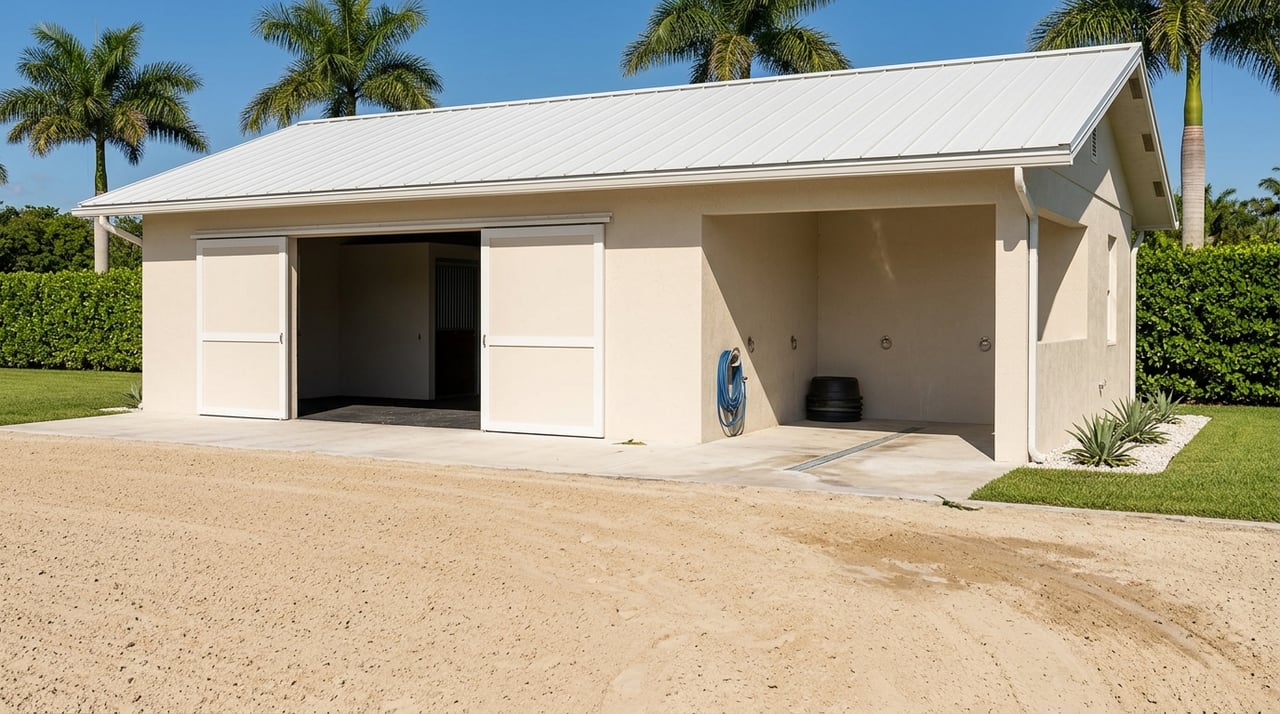
If you hope to add stalls, replace a barn, or extend an existing structure, start with the current footprint and setbacks. Wellington’s EOZD excerpt treats barns, stables, covered arenas, temporary stabling tents, and similar structures as principal uses. That means they must meet principal-structure setback rules.
In Subarea C, the setback table shows 100 feet in the front and rear, 50 feet on the side, and 80 feet on a corner lot for principal structures. Those numbers can have a direct effect on whether a barn expansion is realistic. A property that looks spacious at first glance may still have a tight building envelope once setbacks, easements, and existing improvements are mapped out.
Review arena and turnout layout
Arena plans should be studied just as carefully as barn plans. In Subarea C, dressage walls, sand rings, and riding rings must be 10 feet from any property line. If you want to enlarge an existing arena or shift turnout patterns, that 10-foot rule can quickly shape what is possible.
This is why surveys matter so much in Palm Beach Point. Property lines, drainage swales, and easements can limit how far you can push the arena footprint or move fencing. A redesign that seems minor on paper may require a much deeper site review once those features are considered.
Confirm trail and easement impacts
Trail access is a major draw in Palm Beach Point, but it can also affect redevelopment plans. Wellington’s code states that the village may require dedication of bridle trail easements as part of a development order or building permit for a principal equestrian structure or use. In practical terms, you do not want to assume a barn addition or arena relocation will be simple if the property depends on bridle-path circulation.
Before closing, review the survey, plat, and any visible trail relationship on the site. This step can help you understand whether a planned improvement could trigger extra review, redesign, or delay.
Look closely at drainage and engineering needs
In many equestrian properties, drainage becomes one of the most important upgrade issues. Wellington’s permit checklist states that if your work changes grading, fills swales, adds culverts, or alters drainage, an engineering permit is required in many cases. Even smaller drainage changes may require an engineering permit at the Village Engineer’s discretion.
That means footing quality is only part of the equation. A show-ready arena also depends on how water moves across the property, how the site drains after storms, and whether planned grading changes need engineering review.
Evaluate fencing and waste-area placement
Turnout changes are not just about moving a fence line. The EOZD excerpt regulates fence types and screening, and it requires compost bins and livestock waste storage areas to meet setback rules and be screened from view. If you are redesigning paddocks or service areas, these details should be part of the planning process from the start.
This often becomes relevant when buyers want to create cleaner circulation, add new paddock divisions, or improve service efficiency. A tidy, functional equestrian layout still has to fit within the code framework already in place.
Which Upgrades Are Usually Most Realistic
In Palm Beach Point, the most realistic post-closing improvements are often the ones that stay within the existing setback and drainage envelope. That may include arena footing replacement, regrading, footing-base improvements, barn interior reconfiguration, added storage, fencing updates, and better screening for manure or equipment areas.
These projects can materially improve how a farm functions without requiring a full site redevelopment. They also tend to be easier to evaluate early because the work is often tied to the current layout rather than a brand-new building footprint.
Larger changes require more care. Because barns and covered arenas are treated as principal uses, additions or replacement structures need to be planned against the same setback logic as the primary residence. If you are thinking beyond cosmetic or operational improvements, you should review the site as a whole, not just the structure you want to change.
Covered Arenas And Design Consistency
A covered arena is not categorically prohibited in Palm Beach Point’s Subarea C based on the EOZD excerpt reviewed. The only explicit covered-arena prohibition in that excerpt applies to Subarea F. Still, a covered arena in Subarea C remains a principal structure, so setback and design rules still apply.
There is also a design layer that buyers sometimes miss. The current EOZD language says principal structures in the EPA, including dwelling units, barns, stables, and covered arenas, must be constructed with consistent architectural style, color, and materials. It also says that if multiple structures are re-roofed, they must match within one year of the first project unless ARB approval is obtained.
That makes many Palm Beach Point upgrades more coordinated than they first appear. A new roofline, a barn addition, or a covered arena may need to be considered as part of an estate-wide design plan rather than as a standalone project.
Can You Add More Stalls?
The short answer is: sometimes. The EOZD excerpt reviewed does not provide a universal stall-count cap for Subarea C in the same way it does for some other subareas. That means stall expansion should be treated as a parcel-specific question.
Lot size, building coverage, prior approvals, and any recorded development order can all affect what is possible. If you are buying an older or underutilized farm, this point becomes especially important because the property may have been created under a different site plan or different approval history.
Wellington’s code also states that if a parcel already has a valid development order, that approval remains subject to its original time limits, and amendments submitted after the effective date must follow current regulations. For buyers, that means an older approval does not automatically make a future expansion simple.
HOA And County Issues Buyers Should Not Ignore
Start HOA review early
Palm Beach Point POA has an active community portal that directs owners to the board and management team. Since the public-facing material does not appear to publish a full governing packet, buyers should request the recorded declarations, architectural review process, and amendment history directly from the association or management before assuming an upgrade is permitted.
This is one of the easiest ways to avoid wasted time. It is far better to learn early that a fencing plan, exterior material choice, or site change needs another level of review than to discover that after plans are already drafted.
Understand agricultural status limits
Some buyers assume agricultural status solves permit issues. Palm Beach County states that bona fide agricultural building work may qualify for a building-permit exemption under Florida Statute 604.50, but only when the land is designated agricultural and only for qualifying agricultural uses. Floodplain regulations still apply.
The county property appraiser also notes that agricultural classification is for bona fide commercial agriculture, that new owners must reapply for future years, and that barns, arenas, and storage structures can shift assessment treatment when agricultural classification is granted. In other words, agricultural status can matter, but it is not a blanket pass for all barn or site work.
Watch for drainage easements
Drainage easements can become a hidden cost driver. Palm Beach County states that a removal agreement approved by the Land Development Division is required for construction in drainage easements that drain county roads. If your future plans include moving an arena pad, extending a barn wing, or changing a driveway near an easement, that review can affect both budget and timeline.
For many buyers, this is where technical due diligence creates real value. The visible improvement itself may be straightforward, but the site conditions around it can change the entire scope of the project.
A Smarter Upgrade Strategy In Palm Beach Point
The best approach is to treat barn and arena upgrades as a site-planning exercise from day one. Instead of asking only what you want to build, ask whether the current survey, setbacks, drainage pattern, easements, approvals, and HOA process support that vision.
That mindset can help you prioritize the right property in the first place. In Palm Beach Point, the right farm is often the one with the best upgrade path, not just the prettiest first impression.
If you want help evaluating equestrian properties with both lifestyle and technical fit in mind, Kirsten Kopp Real Estate, LLC can help you assess the details that matter before you close.
FAQs
Can you add stalls after buying a property in Palm Beach Point?
- Sometimes, but you need to confirm setbacks, lot coverage, approved site plans, and any prior development order tied to that parcel.
Can you move or enlarge an arena in Palm Beach Point?
- Usually only if the new layout fits the 10-foot property-line rule for riding rings in Subarea C and does not conflict with easements, swales, or drainage features.
Are covered arenas allowed in Palm Beach Point?
- The EOZD excerpt reviewed does not categorically prohibit covered arenas in Subarea C, but they are treated as principal structures for setback and design purposes.
Does agricultural status remove permit requirements for barn work in Palm Beach County?
- No. Agricultural exemptions may apply in limited situations, but they do not eliminate floodplain rules, drainage review, or all permit requirements.
What is the biggest hidden cost in a Palm Beach Point equestrian upgrade?
- In many cases, the biggest hidden cost is not the barn itself. It is drainage work, easement review, engineering permits, and HOA or architectural review before construction starts.