If you are planning a barn in Paddock Park, the biggest mistake is thinking about stalls first. In this part of Wellington, your barn has to do more than house horses. It needs to fit the lot, support daily circulation, respect drainage, and leave room for turnout, arena space, and future flexibility. That is what makes a barn truly work here. Let’s dive in.
Why Paddock Park barns need a different approach
Paddock Park sits within Wellington’s larger equestrian system, where the Village identifies the equestrian community as a defining part of local life and regulates the area through its equestrian framework. The Village FAQ also notes that Wellington’s equestrian areas connect to an extensive trail network, which is part of why access and movement matter so much when planning a horse property. In this setting, your barn is not an isolated structure. It is one piece of a working equestrian site.
That matters because Paddock Park is generally made up of estate-style equestrian lots, not sprawling ranch parcels. Representative Palm Beach County property records show parcels in Paddock Park 1 around 1 to 1.5 acres, while Paddock Park 2 examples often range from about 2 to 2.7 acres. Some public records even reflect equestrian agricultural use, which supports the area’s identity as an active horse-property neighborhood.
In practical terms, that means every square foot has to earn its place. A barn that looks generous on paper can quickly crowd out paddocks, trailer access, parking, drainage solutions, or arena placement. In Paddock Park, the best barn is usually the one that works as part of a complete site plan, not the one with the highest stall count.
Start with the full site plan
Before you decide on stall numbers or a tack room layout, map the whole property. That includes the house, driveway, trailer parking, turnout areas, arena, service access, waste storage, and drainage paths. If you skip that step, it becomes much easier to overbuild the barn and under-plan everything else.
This is especially important in Paddock Park because public listing examples show a neighborhood pattern of compact but highly functional equestrian layouts. Many properties are designed around direct bridle-path access, short rides to equestrian venues, organized paddocks, and barn-plus-apartment arrangements. That means site circulation is just as important as the barn footprint itself.
A good planning question is simple: how will horses, people, vehicles, and equipment move through the property every day? Once you can answer that clearly, the right barn size usually becomes easier to define.
Size stalls for horses, not guesswork
A functional barn starts with sensible stall dimensions. Extension guidance from UMass Amherst notes that a 12-foot by 12-foot stall is the standard for a typical riding horse, while 12-foot by 14-foot to 14-foot by 14-foot stalls are better suited to a Warmblood or small draft. The same source recommends a foaling stall at least twice the size of a single stall for that horse type.
That does not mean bigger is always better across the board. On a Paddock Park lot, the smarter move is often to size stalls appropriately and keep the overall barn efficient. A barn that is well organized, safe, and adaptable usually performs better than a larger first draft that leaves little room for turnout or circulation.
Extension planning guidance also supports designing for flexibility. A smaller, cleaner layout with room to add a future stall wing can be a better long-term choice than forcing a full build-out too early. In a neighborhood with compact equestrian parcels, that kind of foresight can protect both usability and property appeal.
Choose a practical barn footprint
When possible, extension guidance favors a single-story clear-span barn because it can improve safety, ventilation, layout flexibility, and future expansion potential. That approach also fits the way many upscale Wellington equestrian properties are planned, with simple, legible facility layouts that work well for both daily use and long-term upgrades.
Separate storage also matters. UMass guidance recommends keeping hay and feed storage separate where possible to reduce fire risk and improve management. On a compact lot, that kind of organization can make a major difference in how the property functions day to day.
If you are balancing a residence, horses, and possibly seasonal guests, a clean footprint becomes even more important. Straightforward circulation, defined storage areas, and clear separation between horse functions and living space make the property easier to manage and more adaptable over time.
Put drainage at the center
In South Florida, drainage is not a side issue. It is one of the most important parts of barn planning. The Village of Wellington notes that drainage capacity can be reduced by debris, erosion, and sedimentation, and it states that private drainage systems are the responsibility of property owners and associations. That means you need a barn plan that respects how water actually moves across the site.
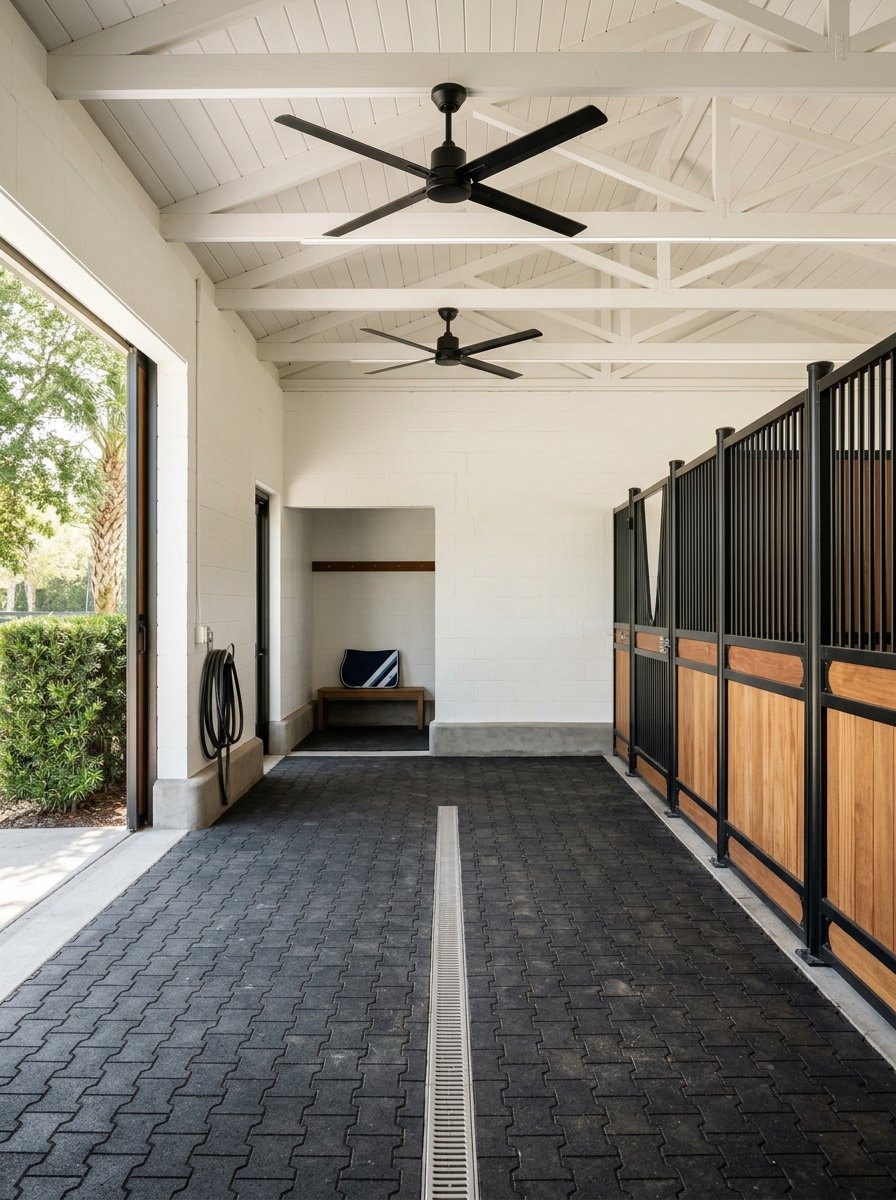
Penn State Extension recommends removing topsoil, compacting the subsoil, sloping the ground away from the stable, and elevating stall floors above surrounding grade. It also favors simple open-channel drainage where possible instead of relying on more complicated underground systems. For wash stalls, it recommends durable, impermeable floors and drainage only where wastewater can be routed appropriately.
For Paddock Park, the takeaway is clear. Place horse traffic, stall entries, and service areas away from low spots and drainage paths. If the site has a higher, better-drained area, that is often where your barn and arena planning should begin.
Plan turnout realistically
Turnout is one of the most common places where owners overestimate what the lot can support. A national Extension resource notes that 2 to 3 acres per horse is a general rule for year-round grazing unless horses are supplementally fed and carefully managed. Since many Paddock Park parcels are much smaller than that, full-pasture grazing is often not the practical model here.
Instead, the property may function better with rotational turnout, dry lots, sacrifice areas, or smaller grass paddocks. That approach aligns more closely with the lot sizes seen in Paddock Park and with Wellington’s drainage realities. It also helps you preserve the areas that matter most for safe, daily horse use.
The goal is not to copy a large farm layout onto a smaller estate parcel. The goal is to create turnout spaces that are easy to maintain, easy to access, and appropriate for how the property will actually be used.
Place the arena with the whole lot in mind
Arena planning should happen alongside barn planning, not after it. In a neighborhood where representative listings show that even parcels around 2.4 acres can support large arenas, multiple paddocks, and direct trail access, the lesson is not that every lot can handle everything. The lesson is that good site planning allows serious equestrian use on a compact footprint.
The best arena location is generally the highest, best-drained portion of the lot, with horse traffic kept out of low areas. You also want to avoid placing key circulation routes where they interfere with drainage paths or create muddy bottlenecks between the barn, turnout, and riding areas.
When arena placement is treated as part of a system, the whole property tends to work better. Horses move more safely, service traffic stays cleaner, and the site feels more intentional from both the ground and the aerial view.
Do not leave manure handling for later
Waste storage should be part of the first draft of your plan. Wellington’s livestock-waste standards, as outlined by the Acme Improvement District, require each livestock facility to have an approved waste storage area with an impermeable floor and sidewalls on three sides, or an approved dumpster on a concrete or asphalt pad with a lip.
The same standards set important separation distances, including at least 5 feet from roof overhangs, 50 feet from public drainage conveyances or inlets, 100 feet from water bodies, and 150 feet from potable wells. Those numbers affect where your barn, wash areas, and service lanes can realistically go.
This is why manure-bin placement is not a cleanup detail. It is a core site-planning decision. Solving it early can save you from awkward circulation, code conflicts, and expensive redesign later.
Build in flexibility for future use
Many buyers in Wellington want a property that can evolve with their plans. That may mean adding a stall wing later, expanding storage, creating a separate apartment, or setting up the farm for seasonal rental use. In Paddock Park, that kind of flexibility can be especially valuable because public listing examples show demand for seasonal farm rentals, barn-only leases, and equestrian properties with apartments attached to the facility.
If future rental use is a possibility, the Village’s current rules matter. Wellington requires a Business Tax Receipt for residential rentals, and it requires a Vacation Rental Special Use Permit for transient rentals offered more than three times in a calendar year for periods under 30 days or one month. The permit is not transferable, so it makes sense to consider guest access, privacy, and parking from the start.
A layout with a separate barn entrance, independent parking, and clear separation between living areas and horse operations is often more adaptable than a plan built only for one owner’s current routine. That does not mean every property should include an apartment. It means your first design should leave room for options.
Think beyond the first permit
Future-proofing starts before the first set of plans is submitted. Wellington handles building permits electronically, and permit corrections must be resolved during the review cycle before approval is issued. That process favors owners who think ahead about the final program instead of treating each addition as a surprise.
If you believe you may want more stalls, a larger tack room, additional storage, or trailer parking later, sketch that future layout now. Even if you build in phases, the property will function better if the ultimate plan has been thought through from the beginning.
That is often the difference between a barn that merely fits and a barn that truly works. In Paddock Park, success comes from designing around the lot, the horses, and the way you may use the property over time.
If you are evaluating equestrian property in Wellington or planning how a Paddock Park farm can function now and in the future, Kirsten Kopp Real Estate, LLC can help you look beyond square footage and into the details that shape daily use, long-term value, and lifestyle fit. Request a private consultation to discuss your goals.
FAQs
What stall size works best for a barn in Paddock Park?
- For a typical riding horse, Extension guidance cites 12' x 12' as the standard, while 12' x 14' to 14' x 14' is often better for a Warmblood or small draft.
Why is drainage so important for barn design in Wellington?
- Wellington places responsibility for private drainage systems on property owners and associations, and Extension guidance recommends grading, elevated stall floors, and drainage that moves water away from the stable.
Can a smaller Paddock Park lot still support an arena and paddocks?
- In some cases, yes. Public listing examples show that compact equestrian layouts in Paddock Park 2 can include arenas, paddocks, and trail access when the site is planned carefully.
What should you know about manure storage for a Wellington horse property?
- Wellington-area livestock-waste standards require an approved waste storage setup and specific separation distances from drainage features, water bodies, wells, and roof overhangs.
Should you plan a Paddock Park barn for future rental use?
- If seasonal or short-term rental use may be part of your long-term strategy, it is wise to consider parking, privacy, and separate access early because Wellington has permit and licensing requirements for certain rental activity.